
New Paltz Town-Village Consolidation: What Voters Will Decide on November 3, 2026 |
After years of study and public hearings, residents head to the polls to determine whether two governments become one |
A Historic Vote Approaches
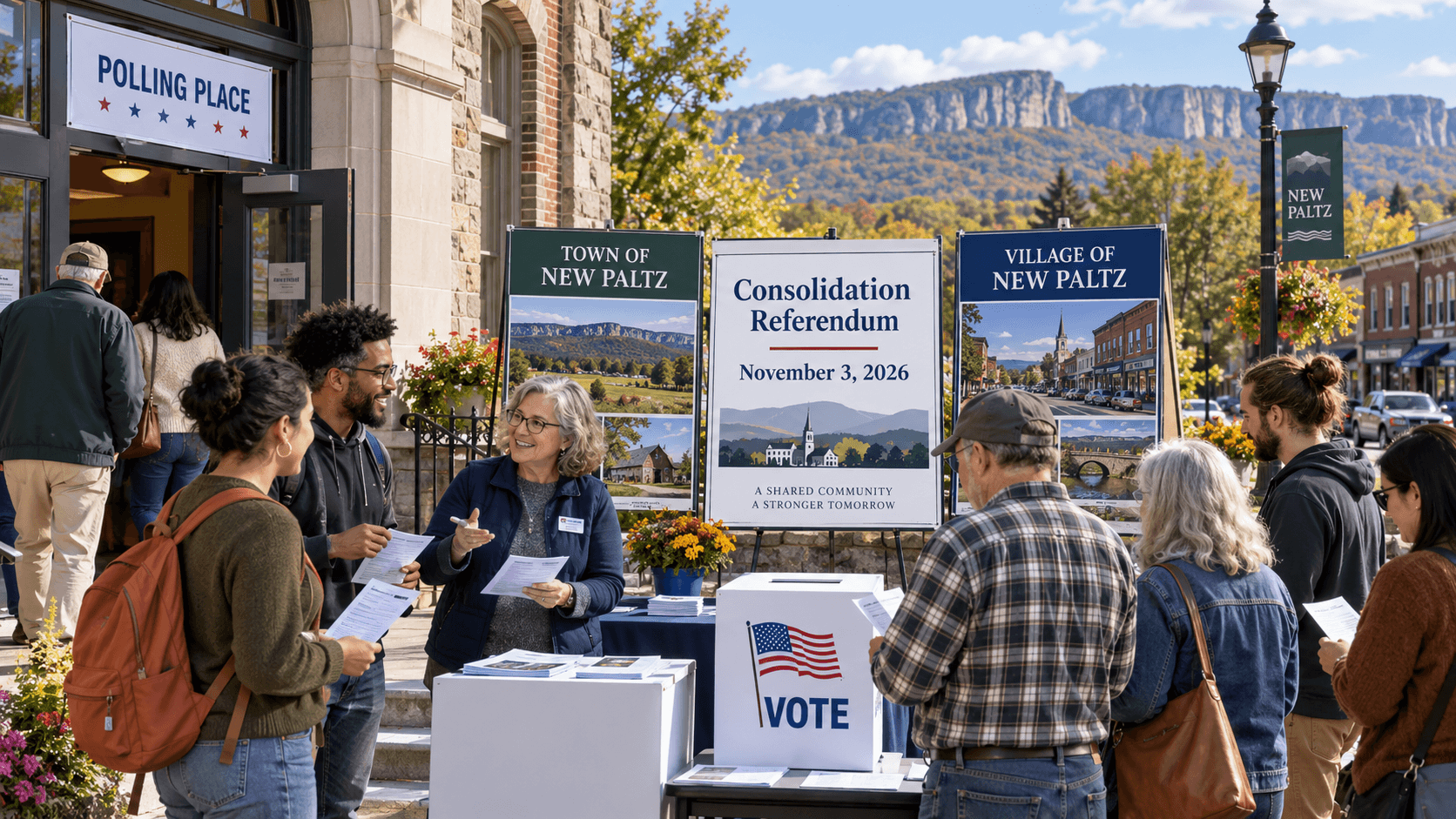
On November 3, 2026, the voters of New Paltz will decide one of the most consequential local government questions in the community's modern history: should the Village of New Paltz and the Town of New Paltz consolidate into a single municipal government?
The question will appear as a referendum on the general election ballot. For consolidation to pass, it requires separate majorities — both a majority of village residents voting "yes" and a majority of town residents living outside the village also voting "yes."
How We Got Here
The consolidation effort gained formal momentum in January 2026, when both the Town Board and the Village Board of Trustees jointly endorsed a Proposed Joint Consolidation Agreement under New York State General Municipal Law Article 17-A. Three public hearings followed in July 2026, drawing standing-room-only crowds and passionate testimony from residents on both sides of the issue.
On August 5, 2026, both boards voted to adopt a final Proposed Joint Consolidation Agreement and set the referendum date. The Village Board approved it by a vote of seven to three.
What the Consolidation Would Do
The Joint Consolidation Agreement (JCA) is the legally required negotiated document that sets out the terms of consolidation — including what would happen to services, employees, budgets, special districts, and governance if voters approve the merger. The agreement addresses how tax rates would be equalized, how village services currently provided only to village residents would be extended or restructured, and how the combined government would be governed going forward.
Arguments on Both Sides
Proponents argue that consolidation would reduce duplication, lower administrative costs, and create a more streamlined government for a community that shares schools, fire protection, and infrastructure. Opponents raise concerns about potential tax increases for some residents, loss of local representation, and the complexity of merging two distinct governmental structures with different service levels and tax bases.
Both sides have established informational websites: the official consolidation information is available at newpaltzconsolidation.info, while an independent opposition site, No New Paltz Consolidation, provides alternative analysis.
What Happens Next
All eyes now turn to Election Day, November 3, 2026. The outcome will reshape local governance in New Paltz for decades to come — or preserve the status quo. Either way, the community is engaged in one of the most significant civic conversations in its history. |



12 Comments
Join the conversation
I am leaning no. A single government might be simpler on paper, but I worry village residents could lose a say in the services they use every day.
Robert F.I get that concern. Do you know how village residents would be represented under the proposed setup? That's the part I'm still trying to sort out.
That concern is central to the debate. The consolidation agreement addresses future governance and village services, and we encourage residents to review those provisions before voting.
I went to one of the July hearings and was glad to see a full room. People disagreed, but at least residents are paying attention before a decision this big.
kim_87I was there too. I hope they hold another public meeting before the vote, since plenty of people still have questions.
Does the agreement say which village services would actually reach people outside the village? That seems important when the two groups have to vote separately.
Leah PatelI'd like to know that too. The agreement talks about restructuring services, but I'd want a clear list of what would change for each area.
I live outside the village and want to see what tax equalization would mean for my bill. Administrative savings sound good, but they need to show us the numbers before November 3.
Dave ThompsonSame here. An example tax bill for a few different properties would be more useful than a general promise of savings.
I support combining the town and village governments if it really cuts duplicate costs. We already share schools and fire protection, so it makes sense to look at what else could be run together.
Thanks for sharing your view. Reducing duplication is a key argument for consolidation. The question for voters is whether the proposed agreement would deliver those savings while meeting residents’ service needs.
Maria G.It's worth looking at. I'd just like to see which jobs and costs actually overlap before assuming the savings will be big.