

Should New Paltz Become One Government? The Town-Village Consolidation Debate |
Public hearings drew packed rooms and heated debate over merging two municipalities into one |
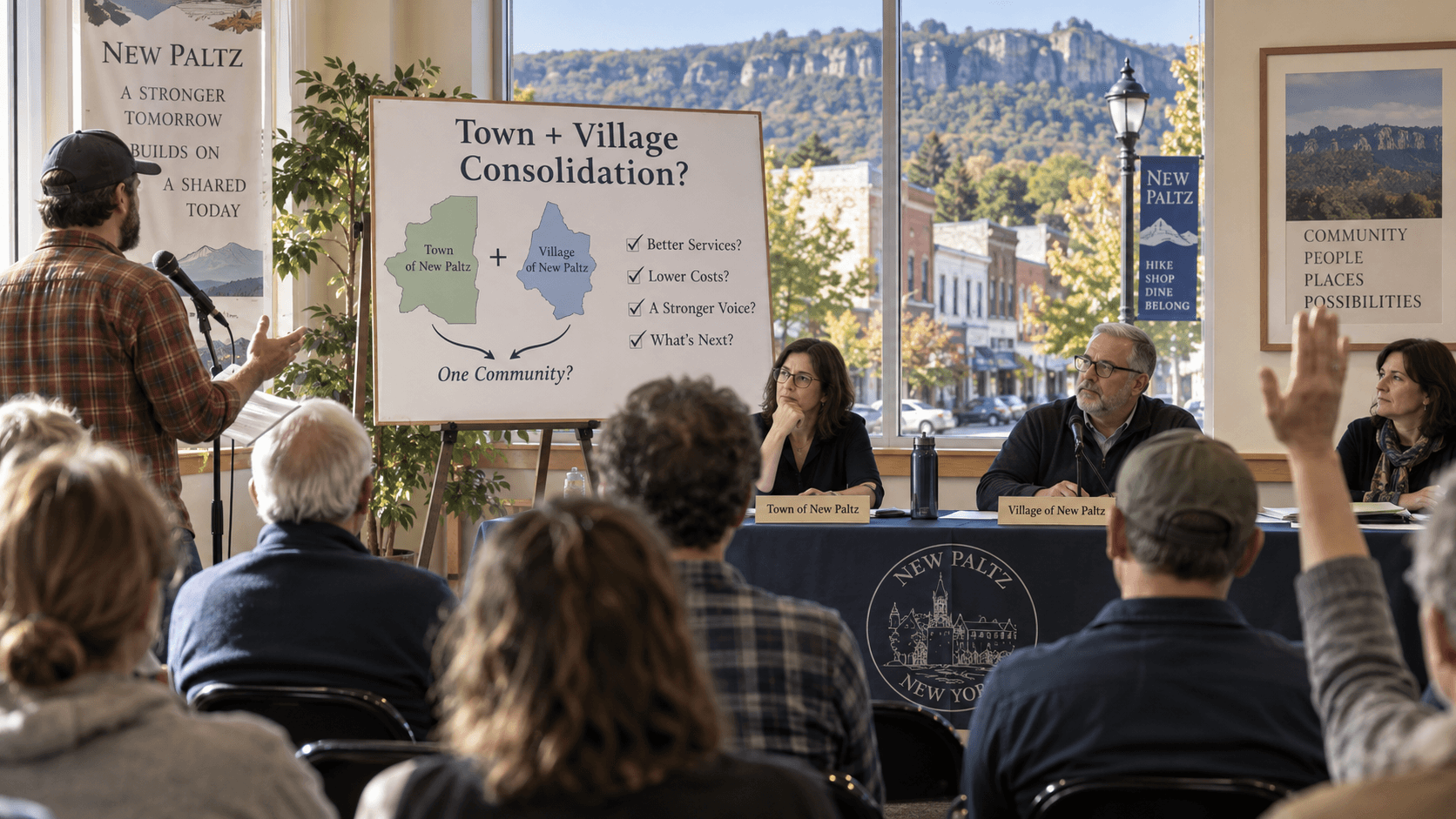
New Paltz is wrestling with a question it has studied for nearly two decades: should the Village of New Paltz and the Town of New Paltz consolidate into a single government?
In January 2026, the Town and Village Boards jointly endorsed a Proposed Consolidation Agreement under New York State General Municipal Law Article 17-A. Three public hearings followed in July, drawing standing-room-only crowds and passionate testimony from residents on both sides.
What's on the Table
The 65-page agreement proposes merging all municipal services — tax collection, code enforcement, highway maintenance, parks — under one Town government. The Village of New Paltz would cease to exist as a separate entity, but all its departments would remain in place, overseen by the consolidated town government.
The proposed effective date is January 1, 2028.
The Numbers
Consultants from the Laberge Group project tax reductions of 2-4% for residents who currently pay only town taxes, and 12-14% for village residents. The village's current fund balance of roughly $2.9 million would transfer to the consolidated town.
Why Some Support It
Proponents argue consolidation eliminates redundant government, reduces administrative costs, and creates a single set of elected officials responsible for all services. They point to decades of shared-services studies that reached similar conclusions.
Why Some Oppose It
Critics at the July hearings raised concerns about losing the village's distinct identity and local control. The village serves a dense, largely rental population with unique needs — including the university, historic Huguenot Street, and a walkable downtown — that may not align with the broader town's priorities.
Some residents also argue the process is moving too fast, with insufficient time for voters to understand a 65-page agreement.
What Happens Next
Both the Town Board and Village Board must separately vote to adopt the final agreement and set a referendum date. If approved, voters in both the village and the town-outside-village must each vote a majority "yes" for consolidation to proceed.
Mayor Alexandria Wojcik has emphasized that the agreement incorporates past studies and aims to protect the village's unique character, including community spaces and services for the high rental population.
Stay Informed
All documents, meeting videos, and updates are available at newpaltzconsolidation.com. Written comments were accepted through August 3, 2026.
Subscribe at explorenewpaltz.com for more New Paltz news, events, and community stories. |


22 Comments
Join the conversation
Glad the village and town voters each have to approve this separately. That seems fair when the tax changes and concerns are different for each group.
Tessa MorganYes, each group should get its own say. The proposed tax savings look pretty different depending on where you live.
January 2028 sounds far off, but there's a lot to sort out before then. I'd rather see the boards slow down than rush the vote.
Rob C.I agree. A 2028 start date doesn't mean voters need to decide before they've had time to read the agreement.
I walk through Huguenot Street most weekends. I hope any final agreement says plainly how its upkeep will be handled.
Nina PatelGood point. Huguenot Street needs regular attention, and I'd like to see who would be responsible for it.
Please spell out how code enforcement would work around the university and downtown. Those areas have different needs from the rest of town.
Jon BellEspecially during the school year, when housing complaints can pile up. Who would residents call under the new setup?
I'm outside the village, so the projected 2 to 4% cut isn't huge. I'd still support it if one office made basic town business simpler.
Sarah K.One place to handle permits and tax questions would be nice. I'd want to know which office we'd actually go to, though.
That’s a fair point. The projected tax cut for town-outside-village residents is modest, but the proposal’s single government could make municipal business simpler.
I was at one of the July hearings and the room was packed. People clearly want time to go through those 65 pages before a referendum is set.
Paul MendezI was there too. A plain-language summary of what changes for residents would help before they pick a vote date.
Thanks for being there. The packed hearings showed how closely residents are following this, and both boards still must vote on the final agreement and set a referendum date. The full documents and meeting videos are available online.
The village's $2.9 million fund balance is a big piece of this. Will that money still be spent on village needs once it goes to the town?
Ellen R.I'd want that spelled out in the final agreement. Otherwise it's hard to know whether village projects would still get funded.
I rent in the village and wonder who would be looking out for downtown renters after this. That part needs a clearer answer before the vote.
kim_87That's my worry too. Renters use downtown services every day, even if they don't get a property tax bill directly.
We've talked about sharing services for years. If the departments stay in place, I can see the case for having one government oversee them.
Dave ThompsonI can see that argument. I'd still like to know whether the departments would keep the same staffing and hours.
A 12 to 14% tax cut for village residents sounds good, but I'd like to know what happens if the savings come in lower than projected.
Maria G.Those are projections, so I'd like to see a budget showing what a smaller savings figure would mean.